


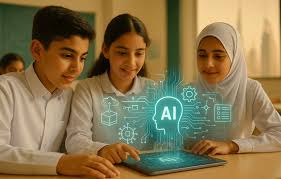
The United Arab Emirates is introducing an artificial intelligence (AI) curriculum for children as young as four in state schools, marking a major step in preparing the next generation for the future workforce. The initiative aims to provide early exposure to AI concepts, ethical practices, and critical thinking, ensuring that students develop essential skills from a young age.
The AI curriculum will provide up to 20 hours of instruction per academic year. Young learners will explore fundamental AI principles, including understanding how AI tools work, identifying AI-generated content, and evaluating information critically. Educators say the program is designed to be age-appropriate, interactive, and engaging, using games, stories, and hands-on activities to explain complex concepts.
Officials emphasized that teaching AI at an early age is critical for building digital literacy. By learning how to use AI responsibly and ethically, students gain skills that will help them navigate increasingly technology-driven workplaces. Authorities stress that early exposure prepares children to become thoughtful users and future developers of AI technologies.
The curriculum also highlights the importance of ethical AI. Children will learn about fairness, accountability, and transparency, ensuring that they understand the societal impact of artificial intelligence. Educators aim to instill responsible digital behavior and encourage students to consider the broader implications of AI in everyday life.
Teachers are receiving specialized training to deliver the AI curriculum effectively. Professional development programs focus on pedagogical techniques, classroom integration, and technology use. Educators will also have access to teaching materials, digital tools, and assessment methods to monitor student progress and understanding.
Education experts say that introducing AI education at an early stage enhances critical thinking and problem-solving skills. Students learn to question information, evaluate sources, and apply logical reasoning. These competencies are increasingly important in modern careers where AI plays a central role in decision-making, innovation, and automation.
The UAE’s initiative aligns with the country’s broader strategy to build a knowledge-based economy. Authorities aim to equip students with the skills needed for the jobs of tomorrow, particularly in technology, science, and innovation sectors. Early AI education is part of a long-term vision to strengthen national competitiveness and workforce readiness.
Parents and communities have welcomed the initiative, recognizing its potential to develop digital literacy and critical thinking skills from a young age. The curriculum ensures that students are not only consumers of technology but also informed decision-makers who can engage with AI in a safe and responsible manner.
Officials highlighted that the AI curriculum will be integrated into existing subjects, including mathematics, science, and coding. This approach allows students to see practical applications of AI in real-life contexts and encourages cross-disciplinary learning. Hands-on projects, interactive exercises, and AI experiments will help reinforce theoretical knowledge.
The curriculum rollout will begin in select state schools, with plans to expand nationwide over the coming years. Authorities will monitor implementation closely, gathering feedback from teachers, students, and parents to improve delivery and content. The program is designed to be adaptable, allowing updates to match rapid advances in AI technology.
By introducing AI education for children as young as four, the UAE demonstrates a commitment to future-focused learning. The initiative ensures that students develop early awareness of technology, ethical understanding, and critical skills essential for the 21st-century workforce. Experts believe that this approach will create a generation of responsible, skilled, and innovative learners capable of shaping the country’s digital future.

