


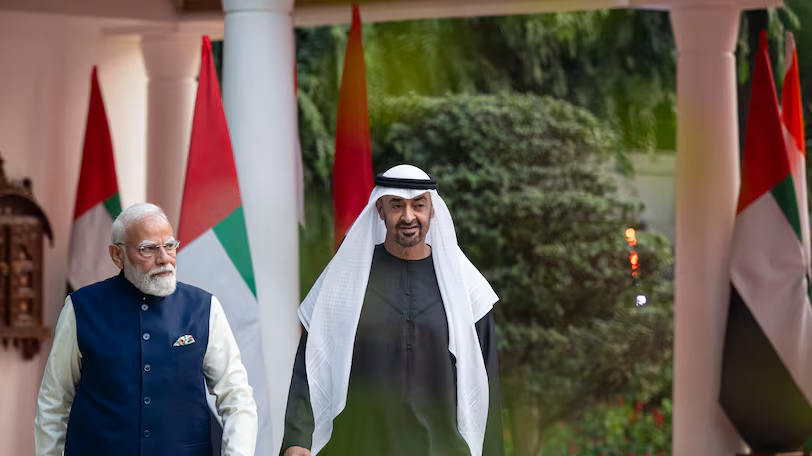
Indian Prime Minister Narendra Modi will visit the United Arab Emirates this week at a time of major global uncertainty. The visit is not only about friendly meetings or business deals. It comes as the world faces rising tensions, unstable energy prices, and changing political alliances.
The relationship between India and the UAE has grown fast over the past decade. What was once mainly based on oil trade and Indian workers in the Gulf has now become a broad strategic partnership. Today, both countries work closely in trade, defence, technology, logistics, food security, and digital development.
Many experts now see the India-UAE partnership as one of the most important links in the modern global economy. Both nations want stronger economic security and greater political influence as the world becomes more divided.
The visit also comes during fresh tensions in the Middle East. Concerns linked to Iran, Israel, and the United States have created fears about regional stability. Global shipping routes remain under pressure, while trade markets continue to face uncertainty.
For India, the UAE is now much more than an energy supplier. The Gulf nation has become an important centre for investment, trade, and diplomacy. India depends heavily on stable oil prices and safe trade routes to support economic growth and control inflation.
Any disruption in shipping lanes or energy supplies can directly affect India’s economy. This makes strong Gulf partnerships very important for New Delhi.
The UAE also gains major benefits from stronger ties with India. As the Emirates continues to reduce dependence on oil income, India offers a huge consumer market and fast-growing technology sector. India’s manufacturing and digital economy also create new business opportunities for Emirati investors.
The two countries strengthened relations further after signing the Comprehensive Economic Partnership Agreement in 2022. The trade deal increased business activity between both nations and opened new paths for investment.
Since the agreement, trade between India and the UAE has grown quickly. India is now among the UAE’s largest trading partners. At the same time, the UAE has become a major gateway for Indian companies entering Middle Eastern and African markets.
Still, the relationship now goes far beyond economics.
India and the UAE increasingly see each other as stable partners in a fragmented world. Both countries are trying to balance relations with major powers while protecting their own national interests.
This balancing strategy has become a key part of both countries’ foreign policies. Neither India nor the UAE wants to rely too heavily on one global power.
Both nations maintain close relations with the United States while also expanding economic ties with China. They also continue diplomatic engagement with Russia, Europe, and developing nations across the Global South.
This flexible approach is becoming more important as competition between Washington and Beijing continues to reshape global trade, technology, and finance.
The UAE has expanded business relations with China but still keeps strong security ties with the US. India has also strengthened strategic co-operation with Washington while protecting its own independence in global affairs.
Because of this, many analysts believe the India-UAE relationship could become a model for other middle powers. Instead of choosing sides, both countries focus on practical partnerships and economic resilience.
Energy co-operation is expected to remain a major focus during Mr Modi’s visit. Rising oil market volatility and regional tensions have increased the need for stable energy partnerships.
Defence and cybersecurity talks are also expected to continue. Both countries have increased co-operation in counterterrorism efforts and defence-related industries in recent years.
Another important issue is the India-Middle East-Europe Economic Corridor, also known as IMEC. The project aims to improve trade routes and transport links connecting India, the Gulf, and Europe.
Although regional instability has slowed progress, both India and the UAE still view the corridor as a major long-term project. Leaders believe it could reshape logistics and trade networks across Eurasia.
The visit also carries strong symbolic value.
In recent years, the UAE has built a reputation for maintaining relations with different global powers at the same time. India has followed a similar path under Mr Modi’s leadership.
Their growing partnership reflects a wider global shift away from rigid political blocs. Instead, countries are forming flexible partnerships based on common interests and economic goals.
As global uncertainty continues, the India-UAE partnership is becoming more important for regional stability and economic growth. The relationship now connects South Asia, the Gulf region, and major parts of the world economy.
Mr Modi’s UAE visit highlights how both countries are preparing for a rapidly changing world while trying to strengthen their position on the global stage.

