


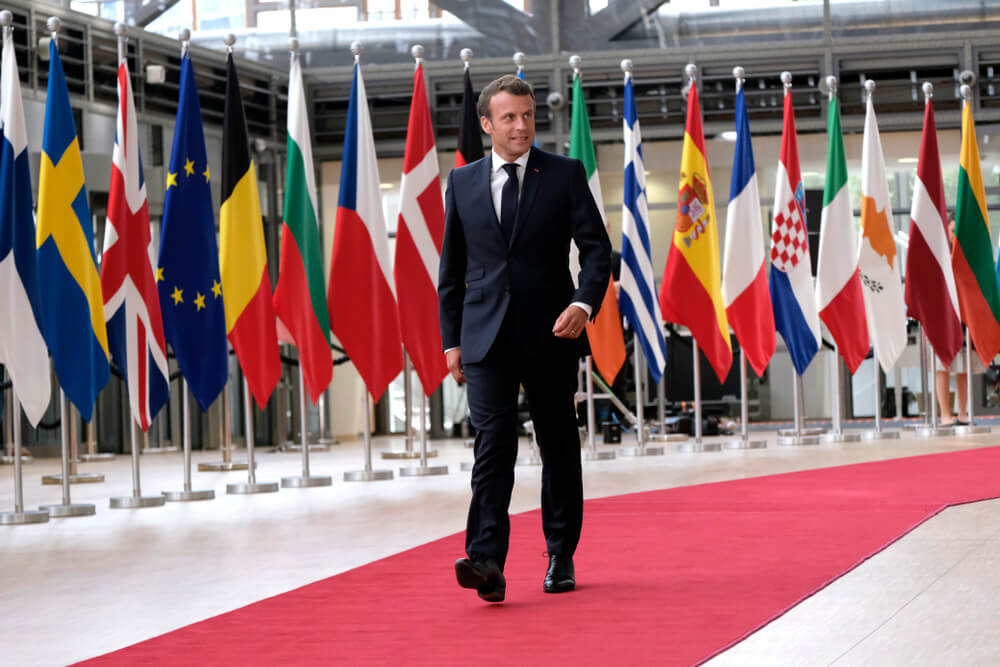
A Renewed Push for European Dialogue
President Emmanuel Macron is set to outline France’s vision for its nuclear deterrent and how it could contribute more broadly to Europe’s security. Speaking from the Île Longue peninsula — home to France’s four nuclear-powered ballistic missile submarines — Macron is expected to stress that any expanded European dimension of France’s deterrence would complement, not replace, the protection offered by the United States.
This marks his first major address on nuclear strategy since 2020, when he proposed involving interested European partners in joint exercises. At the time, the idea drew little attention. Now, however, shifting geopolitical realities have brought it back into focus.
Changing Global Landscape Sparks Interest
Europe’s renewed attention to nuclear deterrence comes amid mounting uncertainty. Russia’s full-scale invasion of Ukraine reshaped the continent’s security outlook, while the return of Donald Trump to the White House has revived concerns about the long-term reliability of American security guarantees.
Recent tensions within NATO, including Trump’s threat of military action against Denmark over Greenland, have only deepened unease, even as European leaders publicly affirm their faith in the alliance. At the same time, Washington has signaled plans to shift more military focus toward the Indo-Pacific, raising questions about the future scale of US forces stationed in Europe.
Macron recently confirmed that he has held strategic discussions with German Chancellor Friedrich Merz and other EU leaders about aligning nuclear doctrines. French officials say global developments — from Russia’s hypersonic missile programs to China’s expanding arsenal and uncertainty around Iran — have heightened interest among European partners in deeper cooperation.
Not an Arms Race, but Strategic Sufficiency
France maintains a doctrine of “strict sufficiency,” meaning it keeps only the number of nuclear warheads it considers necessary to deter aggression. With roughly 300 warheads, its arsenal is significantly smaller than those of the US and Russia, which each possess more than 3,500.
French officials emphasize that Paris is not seeking to enter an arms race but to ensure its capability to inflict unacceptable damage on any adversary. They also stress that any European dimension to France’s deterrent would not compete with NATO’s framework.
France and the United Kingdom have already strengthened cooperation under the Northwood Declaration signed last year, creating a joint Nuclear Steering Group and participating in shared exercises. How France’s broader offer might be structured remains unclear, but the conversation around Europe’s nuclear future is clearly gaining momentum.

