


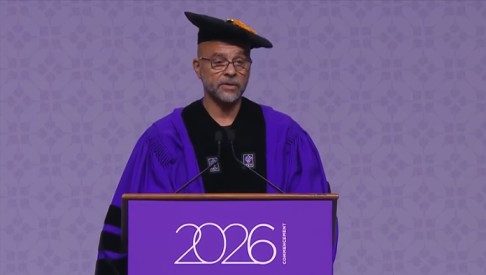
Former Google executive Mo Gawdat delivered a powerful commencement address at NYU Abu Dhabi in 2026. His speech focused on uncertainty, rapid global change, and the challenges facing new graduates entering a world shaped by artificial intelligence, global conflict, and economic pressure.
Gawdat opened his talk with gratitude, saying he felt honored to speak at the ceremony. He told graduates that many of them would go on to shape the future. He said being part of that journey was a privilege for him.
He then shifted to a more reflective message about his own life and career. Gawdat explained that when he graduated as a civil engineer from Ain Shams University in Egypt, the world was far more stable. At that time, career paths were clearer and industries changed slowly.
He said he originally studied civil engineering to please his father, but he was deeply interested in computers and mathematics. After graduating, he faced early career uncertainty while trying to enter the technology sector, which was still in its early stages in Egypt.
Gawdat described how he turned down traditional engineering jobs because he wanted to work in technology instead. After a difficult period without job offers, he said an unexpected moment changed his path. A minor car accident with a friend led to a chance meeting that connected him to a job opportunity at IBM. That role became the start of his tech career.
He used this experience to highlight how life can shift suddenly in unexpected ways. According to him, moments that feel like setbacks can sometimes lead to important opportunities later on.
Gawdat also reflected on his time working with major global companies, including IBM, Microsoft, and Google. He said that during those years, success was based on long-term planning. Professionals could often predict industry trends years ahead and build structured plans to achieve goals.
However, he told graduates that this approach no longer works in today’s world. He said rapid changes in technology, especially artificial intelligence, have made long-term forecasting far more difficult.
Gawdat described the modern world as highly unstable and fast-changing. He said AI is transforming industries every few days, making it harder to rely on fixed career plans. Because of this, he encouraged students to focus on adaptability rather than rigid strategies.
He compared past career planning to a game of chess, where each move can be carefully calculated in advance. He then compared the modern world to squash, where players must react quickly to unpredictable movement. In this new environment, success depends on flexibility and fast decision-making.
Gawdat told students that they should learn to stay alert, respond quickly to change, and return to focus after every challenge. He said the ability to adapt is now more important than long-term prediction.
He also spoke about the emotional side of uncertainty. He reminded graduates that moments of difficulty or confusion should not be seen as failure. Instead, they can be part of a larger path toward growth.
According to Gawdat, many people experience periods where opportunities seem to disappear. However, he said persistence and self-belief often lead to unexpected breakthroughs.
His speech also touched on broader global challenges facing the new generation. He mentioned geopolitical tensions, economic instability, and rapid technological change as key factors shaping the future. He said graduates are entering a world with more uncertainty than previous generations faced.
Despite these challenges, Gawdat expressed optimism. He said young people today also have more tools and opportunities than ever before. He encouraged students to use technology responsibly and to think about how they can contribute positively to society.
The address ended with a message about resilience and flexibility. Gawdat urged graduates to embrace uncertainty instead of fearing it. He said success in the modern world will depend less on predicting the future and more on responding to it with confidence and creativity.

