


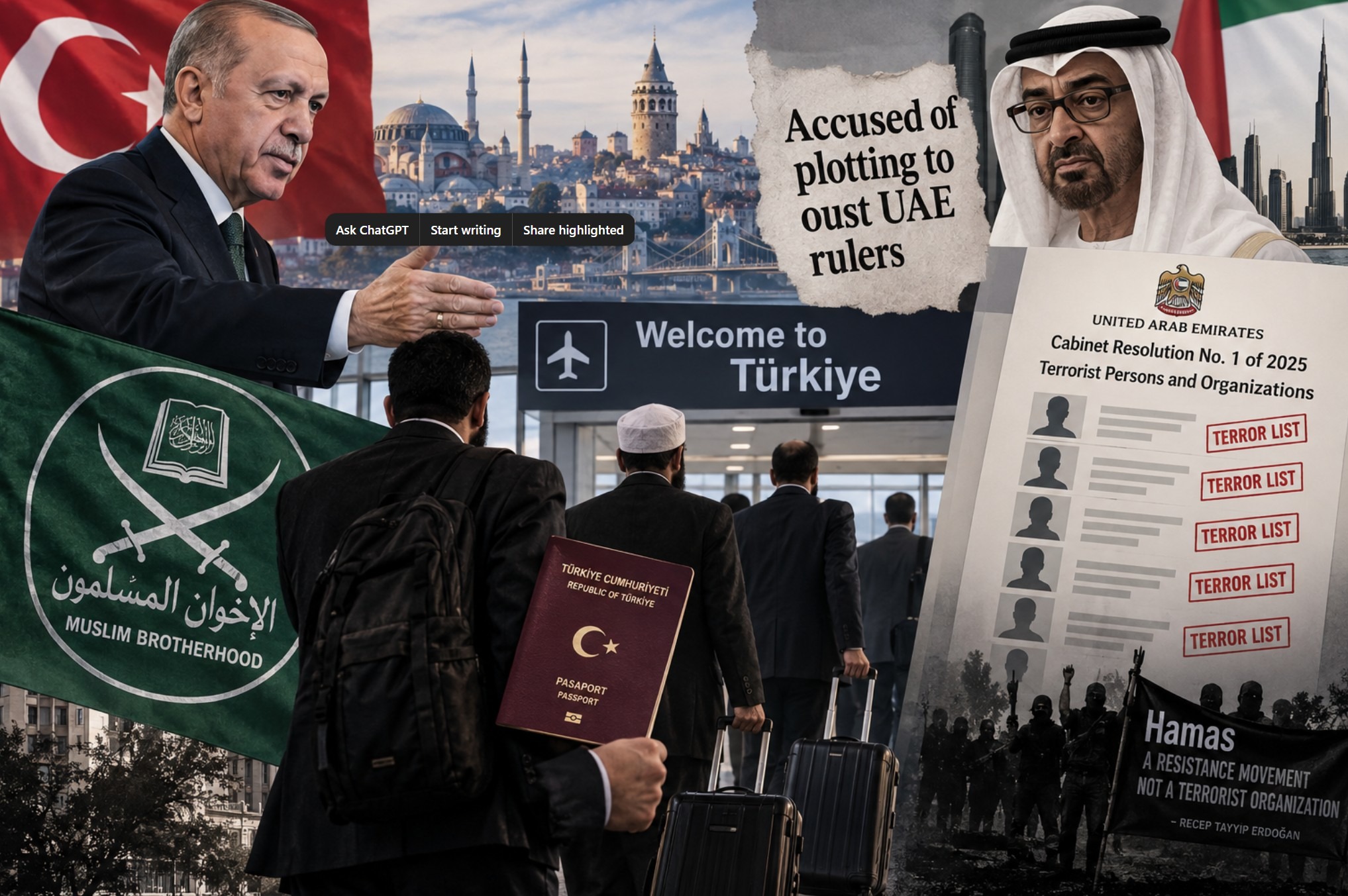
A newly disclosed United Nations communication has drawn attention to claims involving individuals linked to a Muslim Brotherhood network that authorities in the United Arab Emirates accuse of seeking to challenge the country’s leadership.
The document has renewed focus on allegations that several people connected to the network found refuge in Turkey after a major UAE crackdown that began more than a decade ago.
According to the communication, which was sent to the UAE government by four UN special rapporteurs on April 28, 2026, a number of individuals listed by Emirati authorities have lived in Turkey following legal action taken against them in the UAE.
The communication reviewed a decision by the UAE Cabinet to place 11 individuals and eight organizations on the country’s terrorism list because of alleged ties to the Muslim Brotherhood.
The UN document noted that several people named by the UAE had relocated to Turkey after leaving the Emirates. Some of those individuals were reportedly connected to the widely known UAE94 case, while others left the country during the broader crackdown launched in 2012.
The UAE94 case involved dozens of defendants accused by Emirati authorities of attempting to undermine state institutions and challenge the country’s political system. The case remains one of the most debated legal and political matters in the UAE’s recent history.
According to the UN communication, Turkey became a destination for several individuals linked to the network after they departed the UAE. Some reportedly established long-term residency there, while others are said to have continued various activities from Turkish territory.
The issue has attracted attention because relations between Turkey and the UAE have improved significantly in recent years. After a period of political tension, both countries moved toward closer diplomatic and economic cooperation through a series of high-level meetings and agreements.
Despite that rapprochement, allegations involving individuals connected to the Muslim Brotherhood continue to be a sensitive issue between governments across the region.
The Muslim Brotherhood is viewed differently by various countries. Some governments classify the organization or affiliated groups as security threats, while others distinguish between political, social and religious activities linked to the movement.
The UN communication did not determine guilt or innocence regarding the individuals named on the UAE list. Instead, it examined concerns related to the terrorism designations and the legal processes involved.
The document also highlighted the broader movement of individuals associated with Brotherhood-linked networks following political changes that took place across the Middle East after the Arab Spring.
During that period, many activists, political figures and opposition members relocated to different countries after facing restrictions, legal action or political pressure in their home states.
Turkey has often been cited as a destination for groups and individuals associated with Brotherhood-affiliated movements. Analysts have linked this trend to the policies of President Recep Tayyip Erdogan and his government’s approach toward political Islamist movements in the region.
Erdogan has publicly expressed support for Hamas on multiple occasions. In 2025, he stated that he did not consider Hamas a terrorist organization and described it as a resistance movement.
Turkish officials have also maintained contacts with Hamas leaders and have referred to the group as the Palestinian Resistance Movement in official statements.
The latest attention surrounding the UN communication comes after the UAE formally approved a revised terrorism list through Cabinet Resolution No. 1 of 2025. The measure named 11 individuals and eight organizations that Emirati authorities say are connected to activities threatening national security.
The designations included several Emirati dissidents living abroad and at least one person reported to hold both Turkish and Emirati citizenship.
As discussions continue, the Turkey UAE Brotherhood network allegations remain part of a broader regional debate involving security concerns, political movements and differing government approaches toward organizations linked to the Muslim Brotherhood.
The issue is likely to remain under scrutiny as governments, international organizations and legal observers continue to examine the claims and their wider implications for regional politics and security.

