


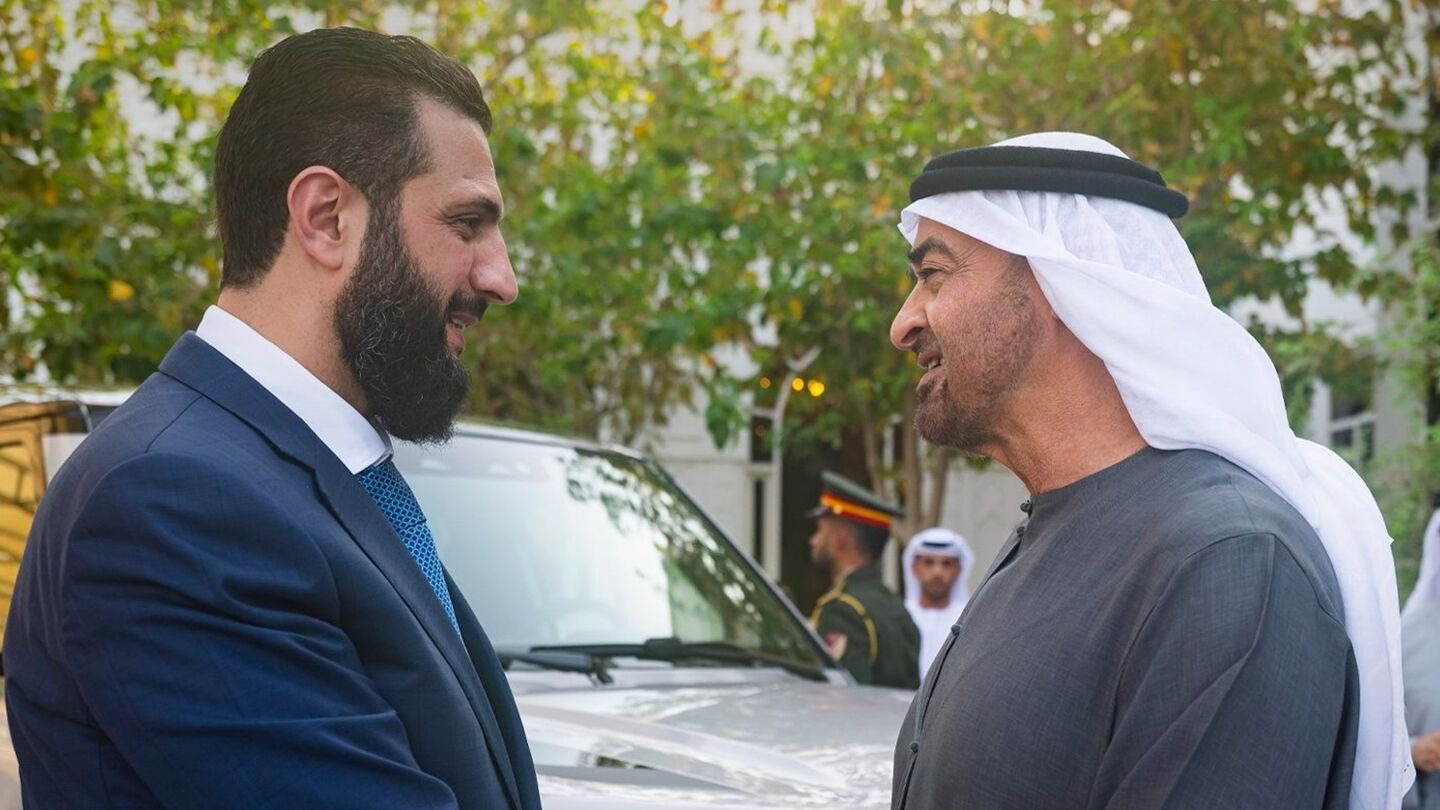
Syrian President Ahmed al-Sharaa and United Arab Emirates President Sheikh Mohammed bin Zayed held talks in Dubai on Tuesday, highlighting the continued growth of economic and political relations between the two countries.
The meeting took place on the sidelines of the Arab Media Summit, an annual gathering that brings together political leaders, government officials and media figures from across the region. According to official statements from both governments, the leaders discussed ways to strengthen bilateral cooperation, with a particular focus on economic and development opportunities.
The two presidents also exchanged views on regional and international developments, reflecting broader efforts to increase coordination between Damascus and Abu Dhabi as relations continue to improve.
Sharaa traveled to Dubai to participate in the summit and used the occasion to promote Syria’s economic recovery following years of conflict. During his speech, he described Syria as a secure trade route connecting East and West and outlined ambitious plans for economic growth.
The Syrian leader said his government aims to increase the country’s economic value to $50 billion by the end of the year. He noted that Syria’s economy was valued at approximately $32 billion last year and around $20 billion following the end of the civil war in late 2024.
Earlier in the day, Sharaa also met with Dubai ruler and UAE Prime Minister Sheikh Mohammed bin Rashid Al Maktoum. The discussions formed part of a broader effort to attract foreign investment and strengthen commercial partnerships as Syria seeks to rebuild infrastructure and expand economic activity.
Economic cooperation between the UAE and Syria has accelerated in recent months. Both countries have pursued investment opportunities in transportation, logistics, energy and real estate sectors.
One of the largest recent developments came in late August when UAE-based developer Arada signed an agreement to build a mixed-use project in Damascus valued at approximately $7 billion. The project is considered one of the most significant foreign investments announced in Syria since the end of the conflict.
In June, Syrian and Emirati officials met in Damascus to discuss transportation links connecting Syria’s Mediterranean ports with Iraq’s Umm Qasr Port and the UAE’s Khalifa Port. The discussions focused on improving regional trade routes and creating new logistics networks linking the Gulf region with the Mediterranean.
The first Syria-UAE investment forum was also held in May, providing another platform for business leaders and government officials to explore cooperation opportunities.
The UAE has shown particular interest in Syria’s potential role as a regional trade corridor. Ongoing disruptions in traditional shipping routes have increased the importance of alternative transportation options across the Middle East.
Syria’s location on the eastern Mediterranean and its proximity to Iraq have strengthened its appeal as a possible gateway for energy exports and commercial trade destined for European markets. Earlier this year, Syria began receiving Iraqi oil shipments transported by truck for export to international customers.
Regional transportation challenges have further increased interest in alternative trade routes. Maritime traffic through the Strait of Hormuz has declined amid tensions involving the United States and Iran. At the same time, security concerns in the Red Sea have continued to affect regional shipping operations.
These developments have encouraged Gulf countries and investors to examine new transportation corridors that could reduce dependence on vulnerable maritime routes.
Despite growing interest, Syria still faces significant obstacles in achieving its goal of becoming a major transportation and logistics hub. Infrastructure damaged during years of conflict requires substantial investment, and the country lacks an extensive pipeline network needed to support large-scale energy exports.
Security conditions have improved considerably since the civil war ended in late 2024. However, challenges remain. Clashes involving government forces and local Druze groups in southern Syria continue to create concerns about long-term stability in some areas.
Relations between the UAE and Syria have evolved significantly since Sharaa assumed power. Abu Dhabi initially adopted a cautious approach due to concerns surrounding political Islam and Sharaa’s previous leadership role in Hayat Tahrir al-Sham during the conflict.
Nevertheless, economic cooperation has steadily expanded. Emirati companies began investing in Syrian infrastructure before recent regional tensions emerged. DP World announced an $800 million investment in Syria and later confirmed operational activity at its port facilities in Tartous.
Trade between the two countries has also grown rapidly. UAE Minister of State for Foreign Trade Thani Al Zeyoudi said non-oil trade between the UAE and Syria reached a record $1.4 billion in 2025, representing a 132 percent increase compared with the previous year.
The latest meeting between Sharaa and Sheikh Mohammed underscores the growing economic partnership as both countries pursue investment, trade and infrastructure projects aimed at strengthening regional connectivity and supporting Syria’s reconstruction efforts.

