


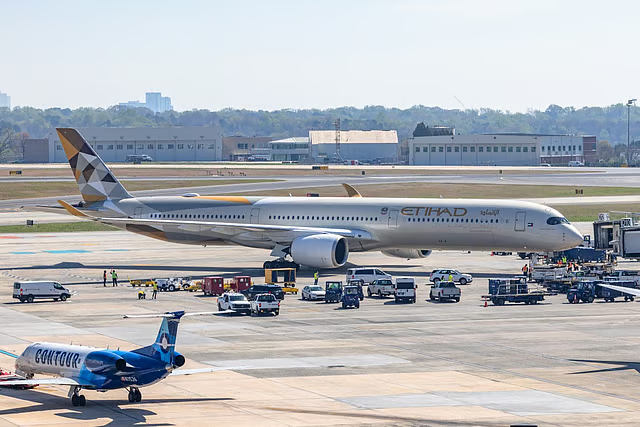
Etihad Airways has launched a new direct service between Abu Dhabi and Damascus, marking a key expansion of its regional network in the Levant. The move strengthens air links between the United Arab Emirates and Syria’s capital, one of the oldest continuously inhabited cities in the world.
The new route officially began on Sunday and is expected to improve travel options for both passengers and businesses. Etihad said the service responds to rising demand from Syrian communities living in the UAE, as well as from families and business travelers who need direct connections between the two cities.
The airline will operate four flights per week between Abu Dhabi and Damascus. Flights are scheduled on Tuesdays, Thursdays, Fridays, and Sundays. The route will be served using the Airbus A321 aircraft, which is designed to offer improved comfort and fuel efficiency for medium-haul travel.
Etihad said the launch is part of its wider strategy to expand its global network and strengthen Abu Dhabi’s position as a major international aviation hub. The airline continues to add new destinations across key global markets as part of its long-term growth plan.
Chief Executive Officer Antonoaldo Neves said the new route reflects Etihad’s commitment to improving regional connectivity. He highlighted Damascus as a city with deep cultural and historical importance in the Middle East. According to him, the connection supports both cultural ties and practical travel needs.
The Abu Dhabi-Damascus route also offers passengers access to Etihad’s wider global network. Travelers from Syria can connect through Abu Dhabi to more than 70 destinations worldwide. These include cities across Africa, Europe, Asia, Australia, and North America.
Etihad’s hub at Zayed International Airport plays a central role in this connectivity. The airport is designed to streamline passenger transfers, reduce travel times, and improve the overall travel experience for international routes.
The airline said the new service is expected to support tourism, business travel, and family visits between the UAE and Syria. It also strengthens economic and cultural links between the two countries at a time when regional connectivity is becoming increasingly important.
Aviation experts say the addition of Damascus to Etihad’s network reflects a broader trend of airlines expanding routes to meet growing demand in the Middle East. Many carriers are focusing on rebuilding and strengthening connections that were limited in previous years due to regional instability.
For Etihad, the move is also part of its competitive strategy against other Gulf carriers. Expanding route networks helps airlines capture transit traffic, where passengers travel through Abu Dhabi to reach long-haul destinations.
Passengers on the new route will benefit from modern onboard services and improved scheduling options. The use of the Airbus A321 is expected to provide efficient operations while maintaining passenger comfort on the relatively short regional flight.
The airline emphasized that the new service is not only about transportation but also about strengthening human connections. It aims to make travel easier for families separated by distance and to support business relationships between the UAE and Syria.
Industry observers note that Abu Dhabi continues to position itself as a major global transit hub. New routes like Abu Dhabi–Damascus support this goal by increasing connectivity and offering more travel options across different regions.
With this launch, Etihad continues its steady expansion strategy, focusing on strategic destinations that support both regional integration and global connectivity. The Abu Dhabi-Damascus route is expected to play a key role in linking travelers between the Levant and the wider world through the UAE capital.

