


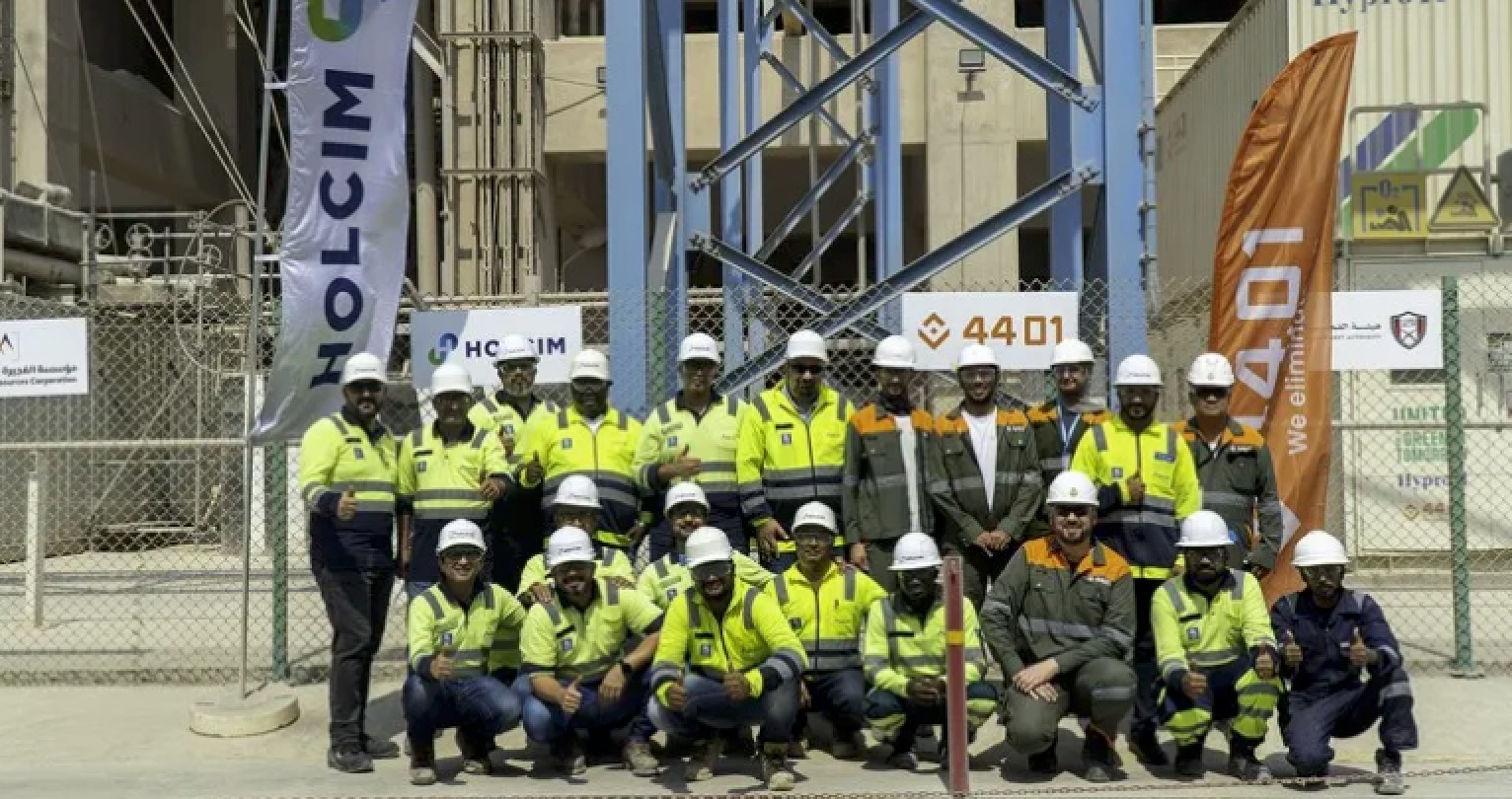
Holcim UAE has launched a landmark decarbonisation initiative alongside climate tech pioneer 44.01.The partnership marks the first carbon capture and underground mineralisation pilot project tailored specifically for the cement sector in the United Arab Emirates.
The pilot facility is set up at the Fujairah cement plant.It extracts emissions directly from flue gas generated during live operations.System operators expect the equipment to capture up to 4.5 tonnes of carbon dioxide each day.This continuous process ties heavy industrial activity directly into local storage networks.
After the gas is trapped, logistics teams move the captured carbon to designated injection sites. Technicians then pump the carbon deep into Fujairah’s natural ultramafic rock layers. The mineralisation tech speeds up a process that usually takes centuries. This reaction locks the gas inside solid carbonate rock forever, preventing leaks.
Building materials giant Holcim UAE brings extensive operational scale to the initiative.Oman-born 44.01 provides specialized expertise in rock mineralisation methods.Several key entities support the project locally.Partners include industrial gas provider Gulf Cryo, technology supplier NT Energies, the Fujairah Natural Resources Corporation, and the Fujairah Environment Authority.
Ali Said serves as Chief Executive Officer of Holcim UAE.He noted that the initiative proves industrial decarbonisation is an immediate reality rather than a distant dream.He stressed that deep cross-industry collaboration remains essential to meet national climate goals.
Cement creation generates roughly eight percent of total worldwide emissions.Most of those emissions come from breaking down raw limestone during processing rather than fuel burning alone.Direct capture combined with geological storage provides a viable long-term solution for hard-to-abate sectors.
The Fujairah site will run tests over the next six months.Engineers will gather operational data to gauge scalability and economic potential. Successful results could allow similar industrial hubs across the Middle East to adopt underground mineralisation.
This project aligns directly with the UAE Net Zero 2050 Strategic Initiative. By turning industrial exhaust into solid stone, local leaders hope to set a clear global benchmark for sustainable building methods.

