


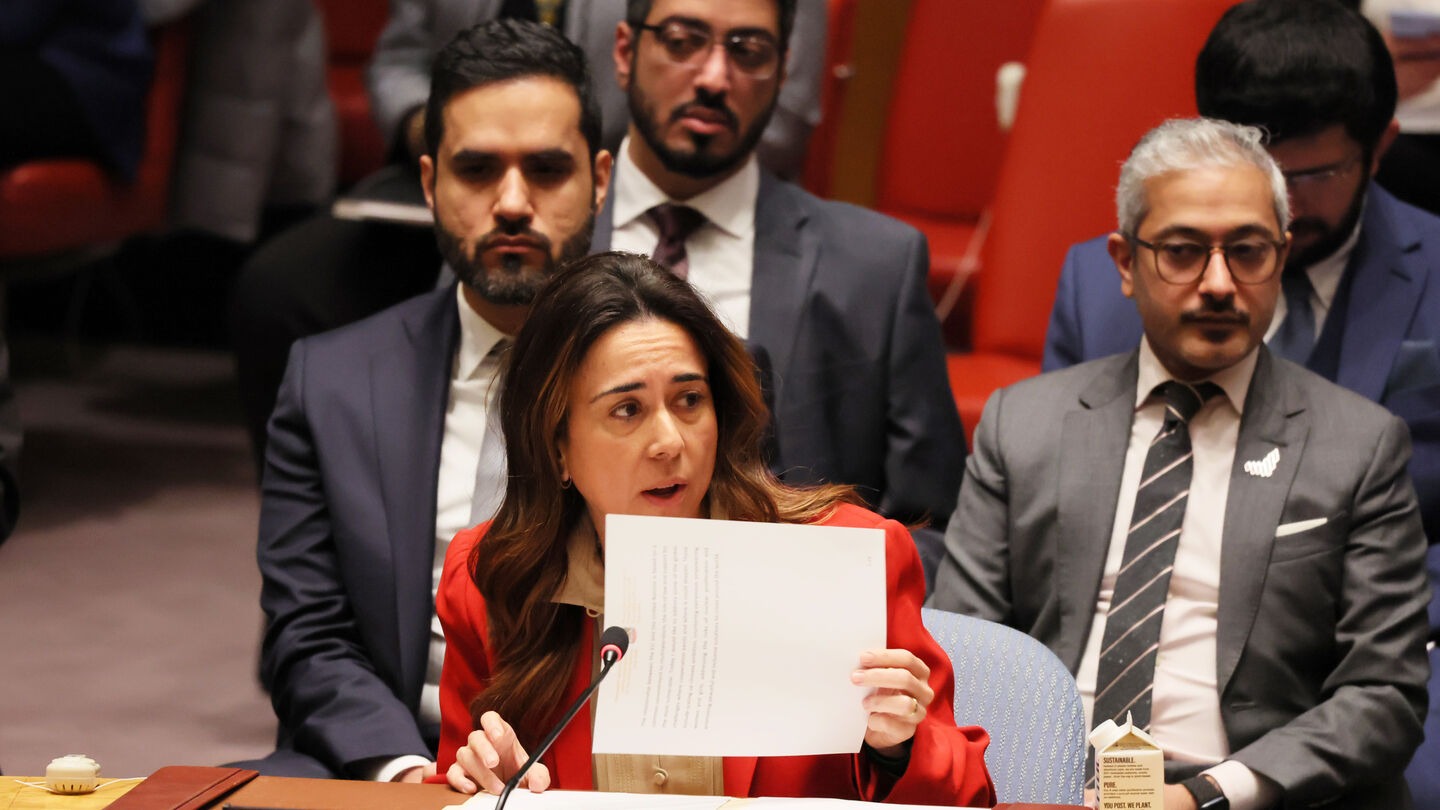
The United Arab Emirates has nominated senior diplomat Lana Nusseibeh to become the next secretary-general of the United Nations. The move adds a Middle Eastern candidate to a competitive race to replace Antonio Guterres, whose second term ends on December 31.
The UAE Foreign Ministry announced the nomination on Wednesday. It praised Nusseibeh’s long experience at the United Nations and her ability to deal with major international challenges.
Nusseibeh currently serves as the UAE’s minister of state at the Ministry of Foreign Affairs. She was the first woman from the Emirates to serve as its permanent representative to the UN. She held that role from 2013 to 2024, including during the UAE’s two-year term on the Security Council.
The next secretary-general is due to take office on January 1, 2027. The selection process comes as the UN faces wars, humanitarian emergencies, and growing divisions among major powers.
Nusseibeh’s nomination adds another option to a race that has drawn attention to Latin American candidates and the possibility of the first woman leading the organization.
A Career in International Diplomacy
Nusseibeh has spent much of her career working on foreign policy and international relations. Before joining the UAE’s top diplomatic team at the UN, she helped establish the foreign ministry’s policy planning department and became its first director.
She also served as the UAE’s co-special envoy to Afghanistan and Pakistan. In addition, she worked as deputy sherpa for the country’s participation in the Group of 20 and led a task force linked to the International Renewable Energy Agency.
Earlier in her career, Nusseibeh worked as a consultant for UNESCO in Paris. She also worked as an analyst with the Gulf Research Center’s Security and Terrorism Programme.
She earned an undergraduate degree in history from the University of Cambridge. She later completed a master’s degree in Israeli and Jewish Diaspora Studies at SOAS University of London.
During her time as the UAE’s UN ambassador, Nusseibeh held several roles within the organization. In 2017, she served as president of the UN Women Executive Board. She was also one of the vice presidents of the General Assembly during its 72nd session.
She helped lead work on reforming and renewing the General Assembly. She also co-chaired the Friends of the Future of the UN, an informal group focused on the organization’s long-term direction.
Work on Gaza and Palestinian Statehood
Nusseibeh’s diplomatic record includes work on the Israel-Palestinian conflict. She has defended the UAE’s diplomatic ties with Israel while also supporting Palestinian statehood.
After the Hamas-led attacks on Israel on October 7, 2023, she condemned the killing of Israeli civilians and the taking of hostages. She described the assault as “unjustifiable.”
During the Gaza war, she helped advance a Security Council resolution in 2023 that created a mechanism to support humanitarian aid deliveries into the territory.
In 2024, she represented the UAE before the International Court of Justice. She supported Palestinian self-determination and a two-state solution while criticizing Israeli policies in the occupied Palestinian territories.
In 2025, she warned that Israeli plans to annex the West Bank would cross a red line for the UAE. She said such a move would threaten efforts to build closer ties across the region.
Nusseibeh has also criticized Hezbollah. In 2023, she accused the group of obstructing UN peacekeepers in southern Lebanon, carrying out military drills, and weakening Lebanon’s state institutions. She warned that these actions could increase regional tensions.
Sudan Issue May Draw Attention
The UAE’s role in Sudan could also become an issue during Nusseibeh’s campaign. Sudan’s government and military have accused Abu Dhabi of supplying weapons to the Rapid Support Forces, a paramilitary group fighting the Sudanese army. The UAE denies providing such support.
Nusseibeh has defended her country against the allegations. She has also called for a ceasefire in Sudan and a political transition led by civilians.
As a candidate for UN chief, she may face questions about how she would address conflicts involving countries with competing interests. The secretary-general must work with member states while seeking support for diplomacy and humanitarian action.
Family Roots in Jerusalem
Nusseibeh’s family has a long history in Jerusalem and Palestinian public life.
Her grandfather, Anwar Nusseibeh, was a prominent Palestinian politician. He held several ministerial posts in Jordan’s government when Jordan controlled the West Bank and East Jerusalem. He later served as Jordan’s ambassador to Britain from 1965 to 1967.
He returned to Jerusalem shortly before the 1967 war and remained there after Israel occupied East Jerusalem. He later broke with the Palestine Liberation Organization, opposing its claim to be the sole legitimate representative of the Palestinian people.
Her uncle, Sari Nusseibeh, is a philosopher and former president of Al-Quds University. In 2001, he became the PLO’s representative in Jerusalem. He later worked with former Israeli security chief Ami Ayalon on a peace initiative supporting a two-state solution.
Nusseibeh’s father, Zaki Nusseibeh, serves as a cultural adviser to the UAE president and is a prominent figure in the country.
If elected, Lana Nusseibeh would become the first woman to lead the United Nations and only the second secretary-general from the Middle East, after Egypt’s Boutros Boutros-Ghali. She has said her candidacy is based on her experience and the challenges facing the region, rather than on her gender alone.

