


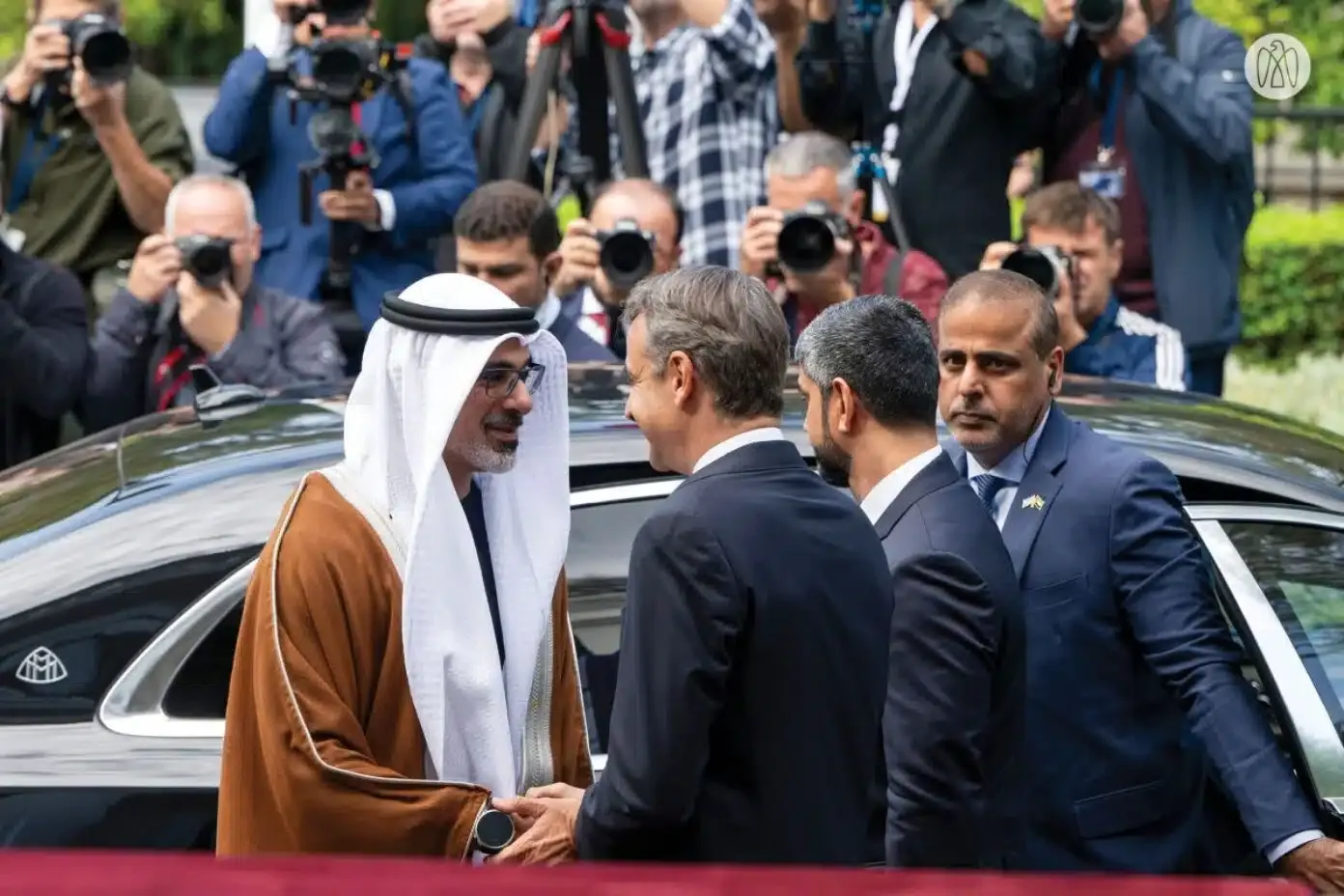
The United Arab Emirates plans to invest an additional €15 billion in Greece over the next five to eight years. The announcement came on October 22 during a visit to Athens by Abu Dhabi Crown Prince Sheikh Khaled bin Mohamed bin Zayed Al Nahyan.
The pledge has been welcomed by the Greek government. It could support major projects in energy, technology, tourism, industry, and infrastructure. However, the planned expansion of data centers has also raised concerns about water supplies and electricity costs.
The new investment is expected to flow through a joint investment initiative launched by the two countries in May 2022. The original program had a value of €4 billion. UAE Minister of Foreign Trade Thani bin Ahmed Al Zeyoudi said the additional funding would cover several sectors over the next five to eight years.
The two governments also announced 18 memoranda of understanding, agreements, and commercial partnerships. Their combined value was reported at €12.75 billion.
However, neither figure means that all the money has been committed to specific projects. Abu Dhabi described the €15 billion as an investment intention. Many of the other announcements are memoranda of understanding rather than completed contracts.
This distinction is important when assessing the likely economic impact. The pledge sets out a broad direction for cooperation, but the final value and timing of individual projects will depend on further agreements and approvals.
One of the clearest developments so far involves renewable energy. Masdar, the UAE’s state-owned clean energy company, already owns Greece-based Terna Energy. It has agreed to buy a solar project with a capacity of more than 550 megawatts from Lightsource bp.
Masdar expects the solar plant to become operational by the end of 2026. The project is also planned to include battery storage. The company said the additional capacity would help meet rising electricity demand linked to artificial intelligence and digital infrastructure.
The transaction still requires regulatory approval. Its completion would provide a concrete step in the wider investment plan and add more renewable power to Greece’s energy system.
Masdar has also signed an agreement with Khazna Data Centers to explore the development of green data centers in Greece. The proposed facilities would use dedicated clean energy and battery storage.
However, the companies have not announced the project’s investment value, planned capacity, or construction schedule. It is therefore too early to determine its full scale or likely effect on local resources.
Interest in data center development in Greece existed before the latest UAE announcement. A study reviewed by the Region of Attica estimates that potential data center investments in the area are close to €1 billion.
Several projects are already under consideration. These include a partnership between UAE-based DAMAC and Greece’s Public Power Corporation, a planned Microsoft complex, and a data center hub worth nearly €300 million in Paiania, near Athens.
The growing interest has raised questions about how these facilities will affect local water supplies. Data centers need large amounts of electricity to operate servers and cooling systems. Some facilities also use substantial quantities of water to control temperatures.
Many sites rely on evaporative cooling systems and cooling towers. Depending on their size and design, large data centers can use hundreds of thousands to several million cubic meters of water each year. The risk can be greater in warm regions where cooling demand remains high.
Attica faces particular pressure because it already has a history of water supply concerns. The region includes Athens and depends on several reservoirs. In September 2025, the Athens Water Supply and Sewerage Company reported that reserves at the Mornos reservoir had fallen to 192.8 million cubic meters.
That level was 64% below the average recorded between 2010 and 2024. Mornos is a major source of water for the Greek capital.
Heavy rainfall during the following winter helped improve the situation. Reservoir reserves nearly tripled between October and April. By March 31, 2026, the four reservoirs serving Attica held a combined 723.6 million cubic meters.
Despite the recovery, supplies remained below the level seen in 2022, when reserves approached 1.32 billion cubic meters. EYDAP’s president warned this year that the underlying water problem had not been resolved.
The effect of future data centers will depend heavily on their cooling technology. Systems that reuse water or rely mainly on air cooling can reduce water consumption. However, air-based systems often require more electricity.
No details have been announced about the cooling systems planned for the proposed Greek facilities. Their actual water and power needs therefore remain uncertain.
The UAE investment plan could bring major economic opportunities to Greece, but its impact will depend on how projects are designed and approved. Clear information on water use, energy supply, and environmental safeguards will be important as the country considers its growing data center sector.

