


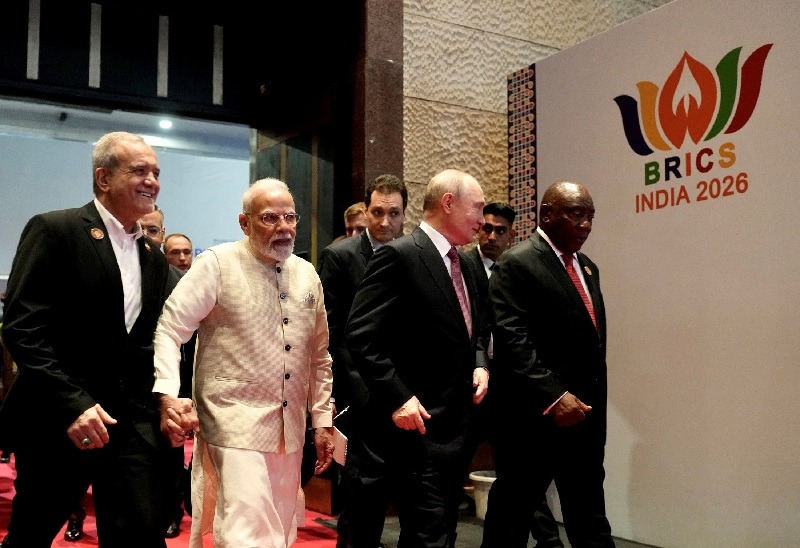
Iran and the United Arab Emirates joined fellow BRICS members in calling for restraint in the Middle East conflict on Saturday, marking a diplomatic development between two countries that have found themselves on opposing sides of the ongoing war.
The appeal came in a joint declaration issued during the opening day of the BRICS summit in New Delhi. The statement urged all parties to avoid actions that could worsen tensions and called for greater efforts to protect regional stability.
The diplomatic move was viewed as a sign of progress between Tehran and Abu Dhabi. Iranian President Masoud Pezeshkian and Abu Dhabi Crown Prince Sheikh Khaled bin Mohamed bin Zayed Al Nahyan also held talks on the sidelines of the summit.
The meeting marked the highest-level direct engagement between leaders of the two countries since the conflict began. While officials confirmed discussions took place, neither side announced any major agreements or breakthroughs.
According to Abu Dhabi authorities, the leaders discussed regional and international developments, de-escalation efforts, stability, and ways to support peace and economic development across the region.
The BRICS declaration reflected a rare point of agreement among member states despite growing tensions in the Middle East.
“We express deep concern over the continued escalation of tensions in the Middle East,” the statement said. The declaration called for maximum restraint and warned against actions that could further increase instability.
The document also emphasized the protection of civilians and highlighted the importance of respecting the sovereignty and territorial integrity of nations. Leaders stressed the need to safeguard global trade routes, supply chains, energy markets, and maritime security.
The summit has drawn global attention as conflict in the Middle East continues. The United States and Iran have exchanged strikes during the six-month war, raising concerns about broader regional instability.
Relations between Iran and the UAE have also been strained during the conflict. Iran has launched several attacks against targets in the UAE, including a strike in late August aimed at Al Minhad Air Base, which housed American military personnel and equipment.
Against that backdrop, diplomats viewed the joint BRICS statement as an important achievement.
Foreign policy analysts had identified the Iran-UAE divide as one of the biggest challenges facing summit organizers. Reaching common language acceptable to both countries was considered essential for demonstrating unity within the bloc.
Experts said the declaration is unlikely to immediately alter events on the ground. However, they argued that it sends a signal that major emerging economies can still find common positions despite deep geopolitical disagreements.
The BRICS group was established in 2009 by Brazil, Russia, India, China, and South Africa. Since then, it has expanded significantly, adding Egypt, Ethiopia, Indonesia, Iran, and the United Arab Emirates.
The expanded membership has increased the bloc’s global influence while also making consensus more difficult on major international issues.
Indian Prime Minister Narendra Modi, host of this year’s summit, said BRICS had matured into a more influential international platform.
Modi urged member nations to transform their shared positions into practical outcomes and strengthen cooperation on global challenges. He also encouraged greater trade and economic collaboration among member countries.
Leaders attending the summit include Russian President Vladimir Putin, Chinese President Xi Jinping, Iranian President Masoud Pezeshkian, and South African President Cyril Ramaphosa.
Xi used his remarks to call for a fairer international order and urged countries to work toward peace in the Middle East.
The Chinese leader said nations should remain committed to political solutions and support efforts aimed at achieving a lasting ceasefire.
China also signaled its willingness to contribute to diplomatic efforts designed to reduce tensions and promote stability across the region.
For India, the summit highlights its role as a bridge between competing powers. New Delhi maintains close relationships with the United States, Russia, Israel, Iran, and Gulf Arab nations, allowing it to engage with multiple sides during periods of conflict.
Former Indian diplomat Sunjay Sudhir said the summit’s value lies in keeping dialogue open between countries with differing interests.
While major disagreements remain, the meeting demonstrated that regional rivals can continue diplomatic engagement even during a period of heightened conflict.
The joint declaration and high-level discussions underscored BRICS’ growing ambition to play a larger role in global affairs as member nations seek greater influence over international diplomacy, economic policy, and conflict resolution.

