


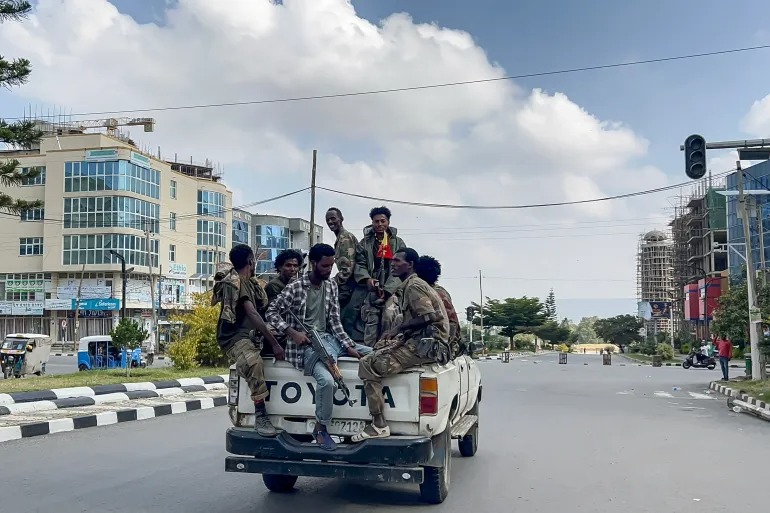
Renewed fighting in Ethiopia’s Tigray region is raising concerns about stability across the Horn of Africa. The conflict has also drawn attention to the roles of two Gulf powers, the United Arab Emirates (UAE) and Saudi Arabia.
The UAE has publicly supported Ethiopia’s federal government. Saudi Arabia, meanwhile, has taken part in regional diplomacy and previously helped support efforts to improve ties between Ethiopia and Eritrea.
The latest violence threatens the peace deal signed in November 2022. That agreement ended a war between Ethiopia’s federal government and forces from the Tigray region. Rising tensions with neighbouring Eritrea have added to fears that the conflict could spread beyond Tigray.
The positions of Abu Dhabi and Riyadh show how outside powers have interests in the region. However, their ability to reduce tensions or influence the parties remains uncertain.
On September 25, the UAE condemned attacks blamed on the Tigray People’s Liberation Front (TPLF) and allied armed groups. The reported incidents included attacks on Ethiopian federal forces and the seizure of airports in Tigray. Fighting has also increased in nearby Afar and Amhara regions.
Sheikh Shakhboot bin Nahyan Al Nahyan, the UAE minister of state, expressed support for Ethiopia’s government and people. He also reaffirmed the UAE’s support for Ethiopia’s sovereignty and territorial integrity.
The UAE called for an end to the fighting, protection for civilians and respect for the Pretoria peace agreement. Its statement made clear that Abu Dhabi supports Ethiopia’s federal government while urging the parties to reduce tensions and pursue dialogue.
However, the statement did not confirm whether the UAE was providing military support. It also offered no evidence that Abu Dhabi had secured promises from the parties to stop the fighting.
The UAE has important commercial interests across the Horn of Africa. Dubai-based DP World operates Berbera port in Somaliland, which lies along the Gulf of Aden. A shipping route launched in 2025 links the port with Jebel Ali in the UAE.
The route offers another channel for cargo moving through the region, including goods intended for inland markets such as Ethiopia. These links give the UAE an economic interest in regional trade and transport.
Ethiopia has been landlocked since Eritrea gained independence in 1993. The country depends heavily on neighbouring Djibouti for access to international shipping. Reliable trade routes are therefore important for its economy and its links with global markets.
The UAE’s commercial ties and relationship with Addis Ababa help explain its interest in stability. But economic links do not necessarily give Abu Dhabi the power to influence every side in the conflict.
It remains unclear whether the UAE can use its close ties with Ethiopia’s federal government to encourage a political solution. Its public support for Addis Ababa may strengthen diplomatic relations, but it does not prove that the government will change its military strategy.
Saudi Arabia’s role has followed a different path. Riyadh has previously supported diplomacy between Ethiopia and Eritrea. The two countries have a long history of tension, despite earlier efforts to improve relations.
Saudi Arabia helped broker a rapprochement between Ethiopia and Eritrea in 2018. The move followed years of hostility and offered hope for stronger ties between the neighbouring countries.
In 2025, Saudi Arabia was also reported to have offered to mediate between the two governments. That reported offer highlighted Riyadh’s interest in limiting regional tensions through diplomacy.
The current crisis could test those efforts. Renewed fighting in Tigray, combined with worsening relations between Ethiopia and Eritrea, creates a difficult setting for any outside mediator. A wider confrontation could affect trade, security and political ties across the Horn of Africa.
The Pretoria agreement remains a key reference point for efforts to prevent a return to full-scale war. Its future depends on whether the parties respect the terms of the deal and pursue ways to settle their disputes.
Civilians face the greatest risks when fighting spreads. Further violence could disrupt local communities, damage essential services and increase pressure on people already affected by years of conflict.
For both Gulf powers, the crisis presents a challenge. The UAE has made its support for Ethiopia’s federal government clear, while Saudi Arabia has a record of regional mediation. Neither position alone guarantees progress toward peace.
The key question is whether outside powers can turn their diplomatic and economic ties into practical steps that reduce fighting. As tensions continue, the actions of Ethiopia’s government, Tigrayan forces and Eritrea will remain central to the region’s future.

