


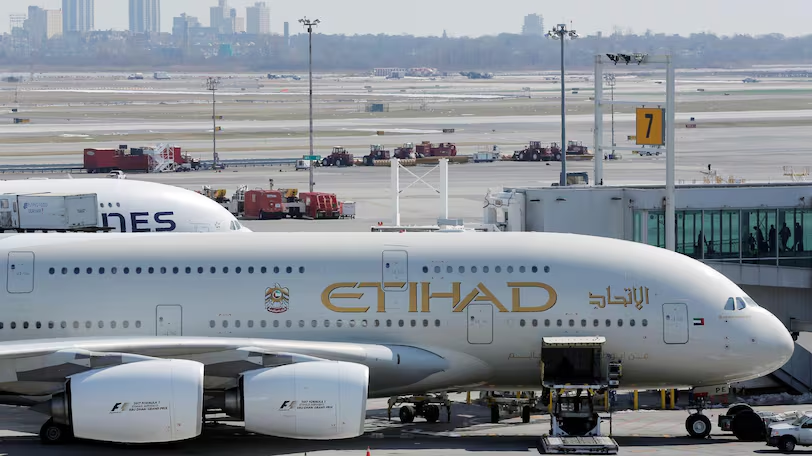
An Etihad Airways flight from Abu Dhabi to London was forced to turn back shortly after take-off on Wednesday morning after a technical issue was detected. The aircraft returned safely to Abu Dhabi Zayed International Airport, and passengers were later moved to an alternative plane.
The incident involved Etihad flight EY061, which was scheduled to travel from Abu Dhabi to London Heathrow. The airline confirmed that the decision to return was made shortly after departure as a precaution. Safety procedures were followed, and the aircraft landed back in Abu Dhabi without any reported complications.
Etihad Airways said the return was caused by a technical issue identified during the early phase of the flight. The airline did not provide further details about the exact nature of the problem. However, it stressed that passenger safety remained the top priority in all decisions taken by its flight crew and operations team.
After landing, passengers were assisted by ground staff at Abu Dhabi airport. The airline arranged an alternative aircraft to continue the journey to London Heathrow. Travelers were advised of revised schedules and supported through the delay process. Etihad said it was working to minimize disruption for all affected passengers.
The disruption also impacted the return service from London to Abu Dhabi. Flight EY062, which was scheduled to depart from London Heathrow on the same day, was delayed as a result of the earlier turnaround. The airline confirmed that this delay was directly linked to the operational adjustment made after EY061 returned to Abu Dhabi.
Etihad issued a short statement confirming both developments. It said, “Etihad Airways flight EY061 from Abu Dhabi Zayed International Airport (AUH) to London Heathrow Airport (LHR) on May 20 returned to Abu Dhabi shortly after take-off due to a technical issue. Guests will continue their journey on an alternative aircraft.”
It added that, “Subsequently, the return flight EY062 from London Heathrow Airport (LHR) to Abu Dhabi Zayed International Airport (AUH) on 20 May will also be delayed.”
Air travel experts say such turnbacks are not uncommon when technical alerts appear during flight. Aircraft are designed with strict safety systems that allow pilots to return to the departure airport if any irregularity is detected. These decisions are typically made as a precaution to ensure passenger safety and aircraft performance standards.
Abu Dhabi Zayed International Airport is one of the busiest aviation hubs in the Middle East. It serves millions of passengers each year and acts as a major base for Etihad Airways. London Heathrow is also one of the airline’s most important international destinations, with frequent daily flights connecting the two capitals.
Flight disruptions on long-haul routes like Abu Dhabi to London can cause a chain effect across schedules. Airlines often need to adjust aircraft rotations, crew schedules, and passenger connections. Even a single technical return can impact multiple flights across a full day of operations.
Etihad Airways operates a large fleet of modern aircraft and follows strict maintenance protocols. All commercial aircraft undergo regular inspections and safety checks before and after flights. In cases where technical issues arise, airlines follow global aviation safety rules set by international regulators.
Passengers affected by the disruption were informed through airport announcements and airline communication channels. Etihad typically offers rebooking support, meal assistance, and alternative travel arrangements during unexpected delays.
While the airline did not report any safety risk, it reaffirmed its commitment to operational safety standards. Aviation safety specialists note that returning to the departure airport is a standard precaution when pilots detect unusual readings or system warnings during early flight stages.
The incident highlights how modern aviation prioritizes safety over schedule. Even minor technical alerts can lead to immediate action to prevent any potential risk during long-haul flights.

