


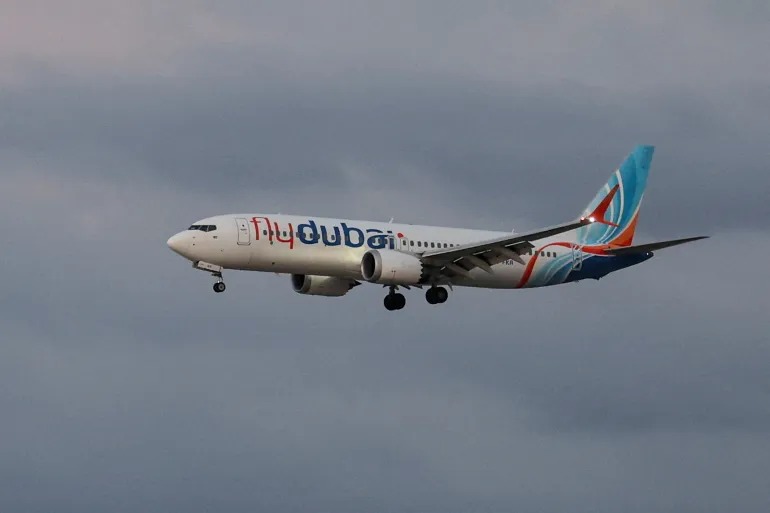
The United Arab Emirates says a Flydubai co-pilot planned to crash a passenger plane at Israel’s Ben Gurion Airport. The alleged plot took place on September 30 during a flight from Dubai to Tel Aviv. Investigators believe the suspect wanted to carry out a suicide attack.
UAE Attorney General Hamad Saif al-Shamsi said the plan may have drawn ideas from the September 11, 2001, attacks in the United States. He shared the findings in a statement released on Friday.
The case began after the co-pilot allegedly attacked the captain during the flight. The aircraft carried 174 people and later made an emergency landing in Saudi Arabia.
The UAE launched an inquiry on October 1. Officials have since shared more details about the suspect, his past, and the events before the attack. The findings offer the clearest account yet of what investigators believe happened.
Investigators Examine Suspect’s Past
UAE prosecutors said the 29-year-old suspect had taken two earlier flights to Tel Aviv. They believe he used those trips to learn about the route and the airport.
Before joining Flydubai in January, the suspect had worked for several airlines in different countries. These included Oman Air and Royal Air Maroc, according to the statement.
Investigators also reviewed the airline’s hiring process. They found that the suspect had met the required work and security standards. He held a pilot’s licence and had provided a certificate of good conduct.
Officials said the checks had not revealed signs of extremist views or plans for a terrorist attack. The statement did not accuse Flydubai of wrongdoing.
The UAE has not officially named the suspect. However, people familiar with the case have identified him as Hamam al-Hammami, an Omani national.
Prosecutors said the suspect told investigators that he had prepared for the attack both mentally and physically. He had watched material that promoted terrorism and taken boxing lessons, according to the statement.
The inquiry also found that signs of his move towards extremism may have appeared in 2017. At the time, he was studying in Australia.
Al-Shamsi said the suspect claimed he had acted alone. Investigators said he gave a detailed account of his motives and how he planned and carried out the attack. His statement was made in the presence of his lawyer.
A Violent Fight Inside the Cockpit
Flydubai Flight FZ1073 left Dubai at 7:05 a.m. local time on September 30. The aircraft climbed to around 34,000 feet as it headed towards Tel Aviv.
A little more than two hours later, the plane began a sudden and steep descent. Flight tracking data showed that it lost more than 17,000 feet in about two minutes. It then climbed and descended again.
According to reports about the incident, a fight had broken out between the two pilots. The co-pilot allegedly stabbed the captain, Indian pilot Smit Machchhar.
Machchhar later described being badly wounded on the cockpit floor as the aircraft dropped in altitude. The incident placed the passengers and crew at serious risk.
Passengers and crew members reportedly rushed to help and overpowered the co-pilot. Their actions helped bring the situation under control as the aircraft levelled out at around 15,000 feet.
The aircraft’s transponder was later set to code 7500. This code signals unlawful interference, including a possible hijacking or similar security incident.
Emergency Landing in Saudi Arabia
Two reserve pilots were also on board the flight. They took control of the aircraft after the cockpit struggle and guided it towards Tabuk in northwestern Saudi Arabia.
The plane landed safely at 9:45 a.m. local time. Saudi authorities said both pilots were taken to hospital for treatment. They were later transferred to Abu Dhabi after doctors cleared them to travel.
The safe landing prevented the incident from becoming a wider disaster. However, the alleged plan has raised serious concerns about aviation security and the checks used to assess airline staff.
The UAE investigation is now focused on the suspect’s actions, past behaviour, and alleged motives. Officials say the evidence points to a plan to crash the aircraft in Tel Aviv.
The case also highlights the risks that can arise when a trained pilot is accused of using access to an aircraft to carry out an attack. Although the suspect reportedly confessed, the allegations remain part of an ongoing criminal case.
The findings released by UAE prosecutors provide new details about the alleged plot. Further legal proceedings and evidence may help establish the full sequence of events and the reasons behind the attack.

