


The UAE government has increased its support for small and medium-sized businesses as the country pushes for stronger local growth and economic stability.
Speaking at the Make it in the Emirates forum in Abu Dhabi, Dr. Ahmad bin Abdullah Belhoul Al Falasi said the government remains committed to helping smaller companies grow despite economic pressure and regional uncertainty.
Al Falasi, who serves as chairman of the Emirates Growth Fund, said access to markets remains the most important factor for long-term business success.
He explained that temporary support can help companies survive for a short time, but stable market access is what allows businesses to expand and create jobs.
The Emirates Growth Fund was created to support companies that often struggle to secure financing. These are businesses that have moved beyond startup stage but still need long-term investment to grow further.
Al Falasi described this area as the “missing middle” in business financing.
The fund focuses on taking minority stakes in businesses. It usually invests between 20% and 49% while allowing founders to stay in control of their companies.
Officials say this method helps companies improve governance and strengthen operations without losing independence.
The fund also offers global expertise and connections that can help UAE firms enter new markets.
Al Falasi said interest in the Emirates Growth Fund has risen sharply after recent announcements. He revealed that demand has reached almost ten times the expected level.
The fund currently has Dh1 billion available for investment. The money is being used across several sectors, including manufacturing, healthcare, food security, and advanced technology.
According to Al Falasi, the strategy is designed to help local businesses become stronger and more competitive in the long term.
He also addressed concerns about regional tensions and investor confidence. Some foreign investors remain cautious because of conflicts in the Middle East, including tensions involving Iran.
However, Al Falasi argued that the actual business risk in the UAE is lower than many outsiders believe.
He said international investors often judge the region as a whole instead of looking at each country separately. Local institutions, he added, understand the UAE market more clearly and can make better investment decisions.
Because of this, the Emirates Growth Fund sees the current environment as an opportunity rather than a setback.
Al Falasi explained that government-backed investment can help businesses deal with rising costs, including higher insurance expenses linked to regional tensions.
The UAE has also introduced corporate tax in recent years, creating new financial pressure for some companies.
Al Falasi acknowledged that many SMEs are adjusting to the added costs. He said fee waivers remain useful, but access to equity funding is becoming just as important.
He noted that companies that are not yet profitable often need extra support to continue growing.
The strong response to the Emirates Growth Fund, he said, shows that many businesses are actively looking for long-term investment rather than short-term aid.
The UAE government is also supporting local companies through direct purchasing programs.
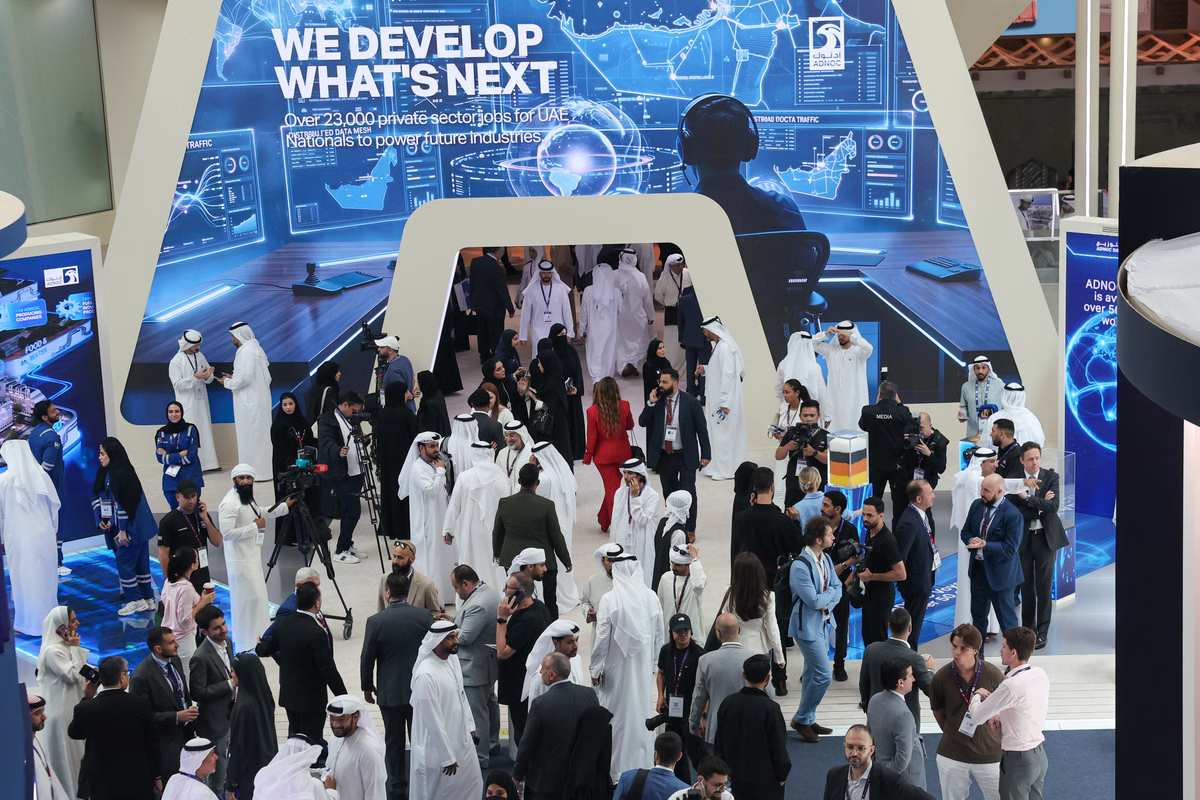
At the Make it with ADNOC forum, held alongside the main event, ADNOC announced projects worth more than Dh200 billion over the next two years.
The company also launched the Local+ initiative. The program connects contractors with 70 qualified UAE manufacturers to increase local production and business activity.
Al Falasi said this shift reflects lessons learned during the COVID-19 pandemic. Supply chain problems during that period showed the importance of local manufacturing and services.
As a result, the government increased efforts to localize industries such as healthcare, defense, and other essential services.
He explained that supporting local companies benefits both businesses and the government by improving economic security and reducing outside dependence.
Al Falasi also compared the UAE’s investment system with Saudi Arabia’s model.
Instead of relying on one major state fund, the UAE operates through several investment groups with different goals and strategies.
He pointed to organizations such as Mubadala, ADQ, and the Emirates Growth Fund as examples of a balanced investment ecosystem.
Each fund, he said, plays a different role in supporting the economy.
The Emirates Growth Fund focuses mainly on growth-stage companies, especially manufacturers and industrial businesses that often struggle to secure equity financing.
Al Falasi said the UAE now has a healthy investment environment with strong support for local businesses.
He added that the country remains confident in its ability to face future economic challenges while continuing to support long-term business growth.

