


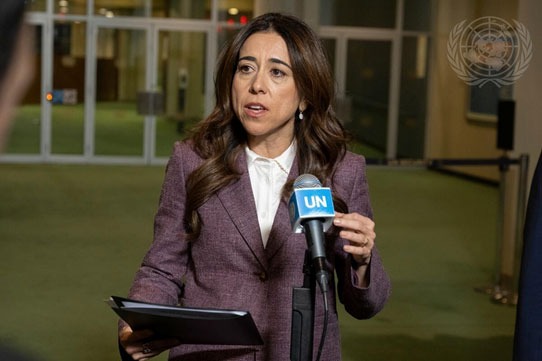
The United Arab Emirates is facing growing criticism over its candidate for the next United Nations chief. Lana Nusseibeh, the UAE’s assistant minister for political affairs, entered the race on October 21. Her campaign has drawn strong objections from human rights experts over allegations that the UAE supports forces accused of mass killings in Sudan.
The next secretary-general will replace António Guterres, whose second term ends on December 31. Nusseibeh’s candidacy comes as the Sudanese civil war continues to cause widespread death, hunger and displacement. Critics say her country’s alleged role in the conflict raises serious questions about her ability to lead the UN and protect civilians.
The conflict in Sudan has grown into one of the world’s worst humanitarian crises over the past three years. Fighting between the Sudanese Armed Forces and the Rapid Support Forces (RSF) has devastated communities and forced millions of people from their homes. Reports have also documented serious human rights abuses and major barriers to aid delivery.
The situation in El Fasher, a major city in Darfur, has drawn particular concern. The RSF laid siege to the city before sharply escalating its offensive last year. Civilians faced severe abuses, while aid workers struggled to reach people in need. Many residents were forced to flee as violence spread through the city and nearby areas.
The UAE has repeatedly faced accusations of supplying weapons, vehicles and logistical support to the RSF. Reports from the United Nations, human rights groups and US intelligence agencies have been cited as evidence of Emirati involvement. The UAE has denied claims that it supports the RSF’s military operations.
In July, Democracy for the Arab World Now, known as DAWN MENA, called on the UN General Assembly and member states to impose an immediate arms embargo on the UAE. The group cited allegations of genocide against non-Arab communities in Darfur and urged international action.
The debate over Nusseibeh’s campaign intensified during a press briefing on October 27. International policy experts, human rights advocates and Sudanese survivors discussed whether her candidacy could weaken the UN’s credibility. They argued that the next secretary-general must be able to address mass atrocities without political pressure from powerful member states.
Ibrahim Alduma, a native of El Fasher and chief programs officer at Sudan Action Hub, described the personal cost of the conflict. He said his family was trapped in the city when the violence escalated. Communication networks were repeatedly disrupted, leaving him unable to determine whether his relatives were alive.
Alduma also recalled learning that a childhood friend had been killed. He did not receive the news until two days after the death. His account highlighted the fear and uncertainty faced by civilians during the siege.
Alduma pointed to a US government determination in February 2025 that the RSF had committed genocide. He also referred to sanctions imposed on seven companies linked to the group. According to his remarks, all seven companies were based in the UAE or had direct connections to the country.
He further accused Nusseibeh of lobbying against a European Parliament resolution that sought to address the UAE’s alleged role in the conflict. He questioned how a diplomat facing such allegations could now seek the world’s top UN position.
Kenneth Roth, the former executive director of Human Rights Watch, also criticized the candidacy. He said the UAE’s alleged military support had helped the RSF achieve battlefield gains. Roth argued that the group would not have been nearly as successful without that assistance.
Roth described Nusseibeh as an unsuitable candidate because she has rejected claims of Emirati involvement in RSF activities. He warned that her denials could undermine her credibility as a potential leader of an international body responsible for protecting human rights.
Roth also argued that the UN cannot afford to be led by someone he believes dismisses evidence of genocide. He compared the situation with former secretary-general Kofi Annan, whom he described as a leader whose work was rooted in human rights and advocacy.
Nathaniel Raymond, executive director of the Humanitarian Research Lab at the Yale School of Public Health, said Western intelligence agencies had tracked the crisis and were aware of substantial alleged Emirati involvement. He recalled that researchers warned the UN Security Council about the danger facing El Fasher in July 2023.
Raymond said the warning signs had been clear long before the worst violence occurred. He argued that diplomatic, economic and security ties between Western governments and the UAE had taken priority over the protection of Sudanese civilians.
The UAE’s position in the race has also raised questions about the wider process of choosing the next secretary-general. Some member states face pressure to elect a woman to the role for the first time. Roth suggested that Nusseibeh’s late entry reflects the difficulty of building agreement among competing governments.
However, critics say gender representation should not outweigh concerns about human rights and accountability. They argue that the next UN leader must be able to investigate allegations of atrocities and press governments to respect international law.
The UAE has rejected allegations of supporting the RSF, while critics continue to demand greater accountability. Nusseibeh’s campaign is now facing scrutiny over whether those accusations could affect the UN’s ability to act impartially in Sudan and other conflicts.
As the selection process moves forward, the dispute highlights a wider challenge for the United Nations: balancing the political interests of member states with its responsibility to protect civilians and respond to serious human rights violations.

