


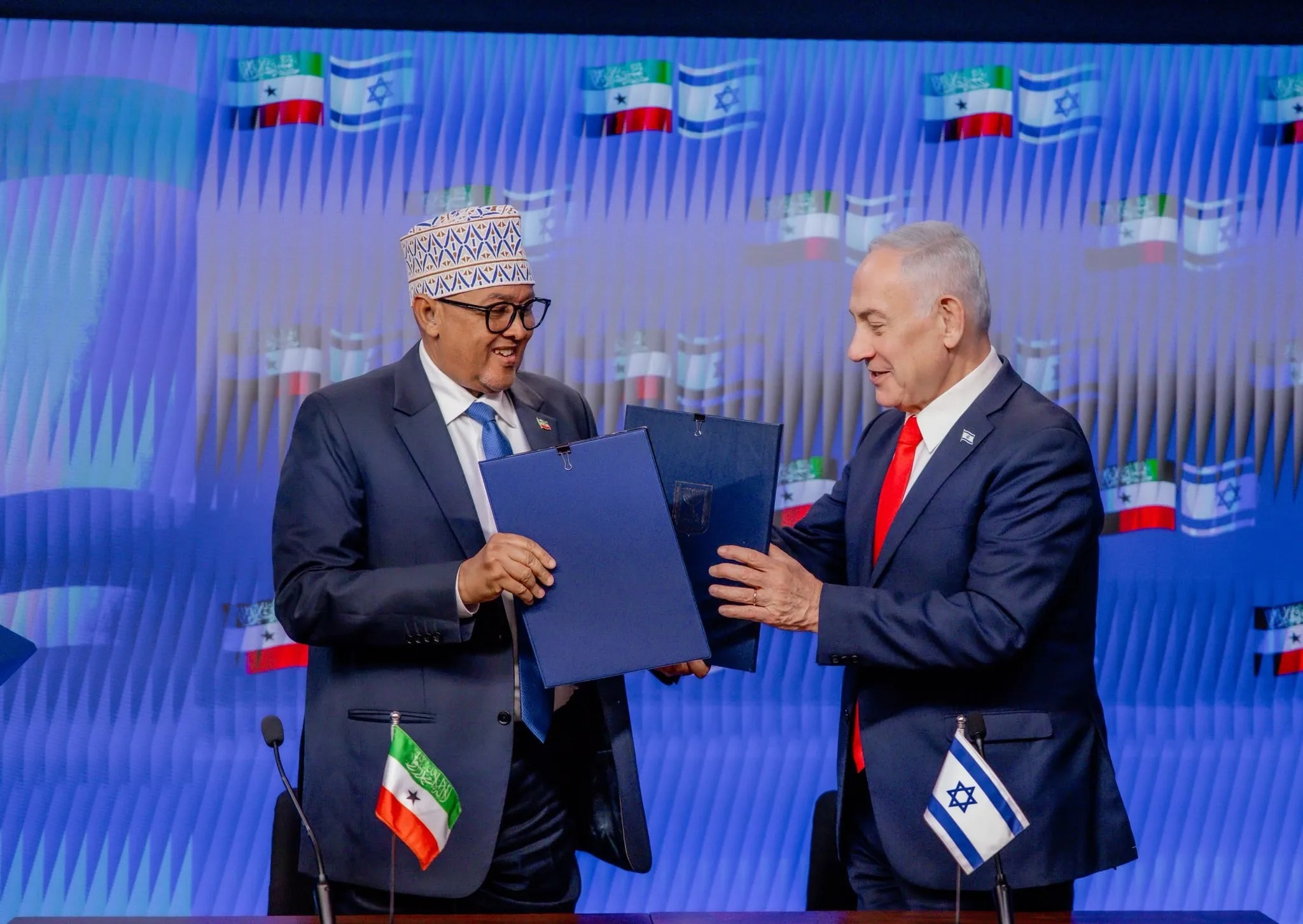
A new report from the European Council on Foreign Relations has shed light on how Saudi officials viewed the United Arab Emirates’ role in Israel’s recognition of Somaliland, adding fresh discussion to an issue that has already reshaped regional diplomacy in the Horn of Africa.
According to the report, a senior Saudi official told a European foreign-policy researcher that Riyadh believed the UAE helped broker Israel’s recognition of Somaliland and that the arrangement included Israeli security access to the strategic port city of Berbera.
The account appears in a report examining the UAE’s expanding influence across the Red Sea region and its increasingly complex relationship with Saudi Arabia. The information was attributed to an interview conducted with a senior Saudi official, though the report did not identify the individual.
The report does not provide independent documentary evidence to support the claim. As a result, the alleged recognition-for-access arrangement remains an assessment attributed to Saudi officials rather than a confirmed agreement.
However, the broader claim that the UAE played a role in facilitating Israel’s recognition of Somaliland has been reported previously. Earlier reports indicated that Abu Dhabi was involved in diplomatic efforts linked to the landmark recognition decision.
Israel formally recognized Somaliland as an independent state on Dec. 26, 2025, becoming the first United Nations member state to do so. The move marked a major diplomatic achievement for Somaliland, which declared independence from Somalia in 1991 and has spent more than three decades seeking international recognition.
Israeli Prime Minister Benjamin Netanyahu said the recognition was consistent with the spirit of the Abraham Accords, which aim to expand relations between Israel and countries across the region.
Somaliland President Abdirahman Mohamed Abdullahi welcomed the decision and expressed his administration’s intention to join the Abraham Accords framework.
The new report introduces a possible security dimension to the recognition by linking it to Berbera, one of the most strategically important ports in the Horn of Africa.
Located on the Gulf of Aden near the Bab al-Mandab Strait, Berbera occupies a critical position along one of the world’s busiest maritime routes. The waterway connects the Indian Ocean to the Red Sea and the Suez Canal, making it a vital corridor for global trade and energy shipments.
The UAE already has significant commercial interests in the port. Dubai-based DP World holds a 30-year concession to operate and develop Berbera, making it one of Abu Dhabi’s most important investments on the African continent.
The report describes Berbera as part of a wider Emirati strategy that combines commercial investment, port management and security partnerships to expand influence across both sides of the Red Sea.
It also points to UAE interests in Bosaso, a key port city in Somalia’s Puntland region. Together, these locations form part of a broader network of economic and strategic assets that support Emirati engagement in East Africa and the Arabian Peninsula.
According to the report, Saudi officials believed the UAE could potentially support similar arrangements elsewhere in the region if political conditions changed. The assessment reflects growing competition between Riyadh and Abu Dhabi for influence in Yemen, the Red Sea and surrounding areas.
Israel’s recognition of Somaliland was strongly opposed by Somalia. Officials in Mogadishu argued that the move violated Somalia’s sovereignty and territorial integrity, maintaining that Somaliland remains part of the Somali state.
The African Union also rejected the recognition and reaffirmed its long-standing position supporting Somalia’s territorial unity.
Tensions between Somalia and the UAE increased sharply after the recognition decision. In January, Somalia’s cabinet announced that it was canceling agreements with the UAE related to Berbera, Bosaso and Kismayo, accusing Abu Dhabi of actions that undermined Somali sovereignty and national unity.
Despite that decision, DP World stated that operations at Berbera would continue.
The ECFR report concludes that ports, trade, investment and security cooperation remain central tools in the UAE’s regional strategy. It also highlights how growing competition between Gulf powers is increasingly influencing diplomatic and security developments across the Red Sea region and the Horn of Africa.

