


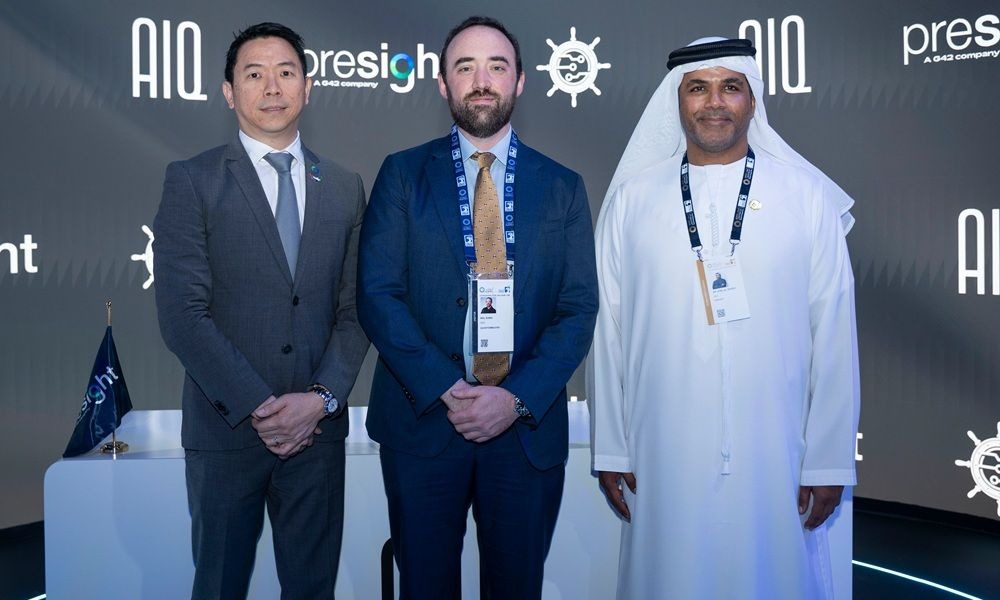
US maritime intelligence firm Quartermaster has signed a new partnership with Abu Dhabi-based AI company Presight. The two firms plan to explore new ways to track ships and improve maritime security. Their first target market is the United Arab Emirates (UAE).
The companies signed a memorandum of understanding during the ADIPEC event in Abu Dhabi. The agreement will allow them to study how Quartermaster’s ship-based sensor technology can work with Presight’s artificial intelligence and data analysis systems.
The proposed system could help monitor vessel movements and detect unusual activity at sea. It may also help identify risks to ports, shipping routes and offshore facilities.
Quartermaster uses a system called SmartMast. It turns commercial ships into mobile monitoring stations. The equipment uses optical, infrared and radio-frequency sensors to collect information about activity at sea. It also has onboard AI tools that can process some of the data.
By joining this technology with Presight’s platforms, the companies hope to create a wider maritime monitoring system. Data collected by vessels could be brought together and analysed to give users a clearer view of activity across key sea routes.
The system could help security teams spot unusual vessel movements and identify possible threats. It may also support the monitoring of busy shipping lanes and important offshore sites.
The UAE will be the first market under consideration. However, the companies may look at other regions if the partnership moves forward. The two firms have not yet confirmed where or when the proposed system will be deployed.
The agreement comes only weeks after Quartermaster secured $140 million in new funding. The money is expected to support the growth of its maritime intelligence network and expand the use of its SmartMast technology.
The funding included a $100 million Series B investment led by Insight Partners. It also included a $40 million venture debt facility from Stifel.
Quartermaster said its SmartMast equipment was already active on more than 650 commercial vessels across 25 countries. The company reported that its network covered around 17.7 million square miles of ocean.
This network gives Quartermaster access to data from ships operating across major international trade routes. The company wants to increase its reach in areas where maritime traffic is high and security risks can affect global trade.
Its expansion plans include several major shipping routes. These include the Strait of Hormuz, Bab el-Mandeb, the Strait of Malacca and the Panama Canal.
These waterways play an important role in global trade. Large numbers of commercial ships use them to move goods, fuel and other products between markets. Better tracking could help improve awareness of vessel activity in these areas.
The Strait of Hormuz is especially important to energy trade. Bab el-Mandeb links the Red Sea with the Gulf of Aden, while the Strait of Malacca is a major route between the Indian Ocean and the Pacific. The Panama Canal also serves as a key link between the Atlantic and Pacific oceans.
For Quartermaster, the agreement with Presight could provide a route into the UAE’s growing technology and security market. It could also help the company make better use of the data collected by its growing network of commercial vessels.
Presight brings experience in artificial intelligence and large-scale data analysis. The company develops systems for government bodies and businesses. It is majority-owned by Abu Dhabi technology group G42.
Its platforms are designed to process large amounts of information and turn them into useful insights. This could support the analysis of data collected through Quartermaster’s sensors.
The partnership may also create new business opportunities for Presight. Working with a maritime intelligence provider could help the company explore more uses for its AI systems in shipping and port security.
However, the agreement remains at an early stage. Neither company has announced a confirmed customer for the combined system. They have also not shared details of a financial commitment or set a date for deployment.
The memorandum of understanding is therefore an agreement to explore possible cooperation, rather than a confirmed technology supply deal.
The next stage will depend on whether the companies can develop a system that meets market needs and offers clear value to customers. For now, the partnership marks a new step in efforts to combine AI, ship-based sensors and maritime data to improve monitoring across key sea routes.

