


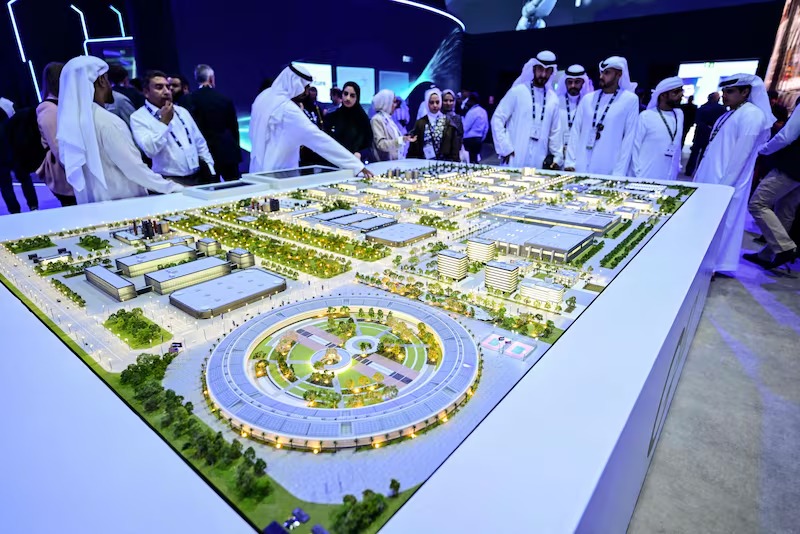
The United Arab Emirates is building a strong position in the global artificial intelligence race. With major investments, advanced computing projects, and access to powerful AI technology, the country is now looking at how these resources can create lasting economic value.
Experts say one promising area is materials discovery. This field focuses on finding and designing new materials that can support future technologies. These materials may include advanced metals, batteries, semiconductors, ceramics, composites, and nanomaterials.
Dr. Amal Abdulla AlGhafri, an Emirati specialist in materials science and nanoengineering, believes the UAE has a rare opportunity to use its growing AI capabilities to accelerate breakthroughs in this field.
The UAE has already taken major steps to strengthen its AI sector. Large-scale investment programs and new computing facilities have placed the country among the leading nations investing in advanced technology. These developments have given the UAE a strong foundation for future innovation.
According to AlGhafri, the next challenge is turning that technological advantage into long-term economic growth. She argues that materials discovery offers a clear path toward that goal because it supports many important industries.
Almost every major technological advance depends on new materials. Modern computers, smartphones, electric vehicles, aircraft, and renewable energy systems all rely on materials that were once considered impossible to create. New discoveries often lead to entirely new industries and products.
For many years, however, developing new materials was a slow process. Scientists often needed decades to move from an idea to a usable product. Researchers would create materials, test them, make adjustments, and repeat the process many times. Success often came only after years of trial and error.
Artificial intelligence is changing that reality.
Modern machine-learning systems can analyze huge amounts of scientific data in a short time. These systems can predict how a material may behave before researchers create it in a laboratory. AI models can estimate strength, durability, conductivity, heat resistance, corrosion resistance, and other important properties.
This allows scientists to focus on the most promising options rather than testing thousands of possibilities one by one. As a result, development cycles that once took decades can now be completed much faster.
Recent progress has demonstrated the power of this approach. Advanced AI systems have identified millions of potential materials in a fraction of the time required by traditional research methods. Experts believe this shift could transform the pace of scientific discovery across many sectors.
For the UAE, the opportunity extends far beyond research alone.
Advanced materials play a critical role in strategic industries. Semiconductor manufacturing depends on specialized materials. Energy storage systems require better batteries. Aerospace companies need lighter and stronger components. Water treatment technologies rely on advanced filtration materials. Defence systems also depend on high-performance materials.
Because these sectors support national development, faster materials discovery could strengthen economic competitiveness and improve industrial capabilities.
The UAE has repeatedly stated its goal of building a knowledge-based economy. Artificial intelligence is expected to be a key driver of that transformation. By combining AI infrastructure with scientific research, the country could create new areas of expertise and attract investment in high-value industries.
Experts say success will require strong cooperation between universities, research centers, government agencies, and private companies. Building databases, training specialists, and supporting innovation programs will also be important steps.
Investment in this area could help create new businesses and high-skilled jobs while reducing dependence on traditional economic sectors. It could also position the UAE as a global center for advanced materials research.
The rapid rise of artificial intelligence has created opportunities that were difficult to imagine only a few years ago. Materials discovery is emerging as one of the most promising applications of this technology.
As the UAE expands its AI capabilities, many researchers believe the country is well placed to lead the next wave of innovation. By using artificial intelligence to accelerate the search for new materials, the nation could help shape future technologies while supporting long-term economic growth and scientific advancement.

